QUICK LOOK DATA
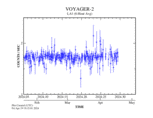
The most recent Voyager 6-hour averages for the LA1 (> 0.5 MeV/nuc
nuclei) and PGH (> 70 MeV/nuc nuclei) rates are shown below in
selectable thumbnail images.
The LA1 rate consists of greater than 0.5 MeV/nuc nuclei, principally
protons, and is sensitive to low-energy phenomena in interplanetary
space (e.g., co-rotating interaction regions, associated enhancements
and solar flares).
The PGH rate consists of greater than 70 MeV/nuc nuclei, primarily
protons, and is a good indicator of the level of modulation of galactic
cosmic rays. It can also respond to large solar flares.
DATA INTERFACES
Through the Rate, Flux and Spectra User Interfaces you may generate
figures and download CRS data for the lifetime of the Voyager mission.
These interfaces have been tested with Microsoft Edge, Chrome and
Firefox browsers.
Note
The Voyager 1 heater was turned off in May, 2022. Corrections have been
applied to the Voyager 1 flux data from DOY 145/2022 (May 25). Voyager
1 flux data from May 18 - May 24, 2022 are not available.
The Voyager 2 heater was turned off in June 2019. Corrections have been
applied to the Voyager 2 flux data from DOY 178/2019 (June 27). Voyager
2 flux data from DOY 160/2019 to DOY 178/2019 (June 9 - 26) are not
available.
See Voyager-2 Temperature Corrections
for additional information.
The Rate data has not been corrected so please use caution using V1 Rate
data after DOY 138/2022 (May 18) and V2 Rate data after DOY 159/2019
(June 8).
DOCUMENTATION